REVIEW · ROME
Florence: Uffizi Gallery Small Group Guided Tour
Book on GetYourGuide →Operated by Italy Wonders · Bookable on GetYourGuide
Big art, handled with real pacing. This Uffizi Gallery tour gives you skip-the-line entry and a live guide to walk you through major Renaissance hits like Botticelli’s Birth of Venus and Primavera, plus Michelangelo, Caravaggio, Titian, and Raphael. I like that it’s tightly timed to keep the museum from turning into a shuffle. The one catch: in peak season, security lines can still slow things down at the start.
My favorite part is the way the guide connects each painting to what you’re actually looking at—Botticelli’s myth and symbolism, Michelangelo’s carved-feeling figures in the Tondo Doni, and Caravaggio’s raw intensity. I also love that the tour is only 1.5 hours, so you get the big names and the meaning without feeling trapped for half a day. Because it’s small-group and structured, you’ll get a smoother start than if you wing it.
In This Review
- Key Highlights You’ll Actually Care About
- Uffizi in 90 Minutes: What This Tour Covers
- Meeting at Piazzale degli Uffizi: Find the Andrea Obgagna Statue
- Skip-the-Line Entry: How to Think About Time Savings
- Inside the Uffizi: A Guided Route Built Around Big Names
- Botticelli’s Myth and Meaning: Birth of Venus and Primavera
- Michelangelo’s Tondo Doni: Seeing Sculpture Feelings in Paint
- Caravaggio’s Dramatic Realism: The Emotional Shock
- Titian and Raphael: Big Beauty, Clear Takeaways
- Guide Quality and Pacing: Why Mateo Is a Standout
- Price and Value: Is $100.40 Worth It?
- Who This Tour Suits Best (and Who Might Skip It)
- Practical Tips for a Smoother Uffizi Visit
- Should You Book This Uffizi Gallery Small-Group Tour?
- FAQ
- How long is the Uffizi Gallery tour?
- Does the tour include skip-the-line entry?
- Where do I meet the host?
- Where does the tour end?
- What artworks does the tour focus on?
- What languages are available for the guide?
- Is hotel pickup or drop-off included?
- Are food and drinks included?
- Is the tour wheelchair accessible?
- Can unaccompanied minors join?
- What should I do before the tour starts?
Key Highlights You’ll Actually Care About
- Skip-the-line entrance helps you get moving toward the art faster
- 1.5-hour guided route keeps attention from drifting in a huge museum
- Botticelli to Raphael in one tour covers the headliners most people come for
- Caravaggio’s dramatic realism is treated like the emotional story it is
- Live guide in Spanish, Italian, or English, with excellent pacing (I’m a fan of how Mateo runs his tours)
Uffizi in 90 Minutes: What This Tour Covers
The Uffizi is famous for a reason, but it’s also big, busy, and easy to get lost in rooms you didn’t plan to see. This tour is designed to solve that problem fast: you get a focused, guided pass over the masterpieces most visitors hope to find. The total time is about 1.5 hours, so it’s realistic even if you only have one morning or one afternoon in Florence.
Instead of letting you wander until you’re tired, you’re guided from the start point at Piazzale degli Uffizi into the museum and through a sequence of major works. Along the way, you’ll hear explanations that help you notice details you might otherwise miss—especially with artists like Botticelli and Caravaggio, where symbolism and emotion are part of the point, not just the subject.
If you love art, you’ll enjoy the momentum. If you’re more casual, you’ll still come away feeling like you saw the right stuff and understood what makes these paintings matter.
You can also read our reviews of more guided tours in Rome

Meeting at Piazzale degli Uffizi: Find the Andrea Obgagna Statue
Let’s talk logistics in plain terms, because the best tour still starts with you in the right place. You meet your host in front of the Andrea Obgagna Statue in Piazzale Degli Uffizi. It’s described as the first statue on the left, sitting in the corner between Piazzale degli Uffizi street and Via della Nina street.
Two things help your day go smoothly:
- Arrive 10 minutes early. If you show up at the start time, you’ll burn energy just finding the group.
- Use the correct email and phone number for updates. Changes happen, and you want the message.
And a small practical note: this tour ends back at the meeting point, so you’re not stuck figuring out what to do afterward. You leave with your bearings and you can continue exploring Florence at your own pace.
Skip-the-Line Entry: How to Think About Time Savings
This tour includes skip-the-line entrance through a separate entrance. That matters in Florence because crowds can turn the simplest museum plan into a waiting game. The goal here is straightforward: reduce the time you spend standing, so you spend more time looking and listening.
That said, be realistic. The important detail is that in high season, security waiting time can still be longer. So while the tour helps with museum entry, you should still expect some friction at the start. If your schedule is tight, I’d treat this as a “time saver,” not a “time miracle.”
Inside the Uffizi: A Guided Route Built Around Big Names
Once you’re inside, the tour becomes a quick crash course in why Renaissance art still hits people today. The guide keeps you moving and looking in the right direction, which is exactly what you want in a museum like this.
This is also where the small-group format helps. You’re not shouting questions into a crowd or waiting for everyone to catch up. You get a more conversational flow, and the license guide can tailor explanations as you go—especially when the works are so well known that people often have the same questions.
The route is about key paintings you’ll recognize instantly. But the real win is that you don’t just see them—you learn what to notice while you’re staring at them.
Botticelli’s Myth and Meaning: Birth of Venus and Primavera
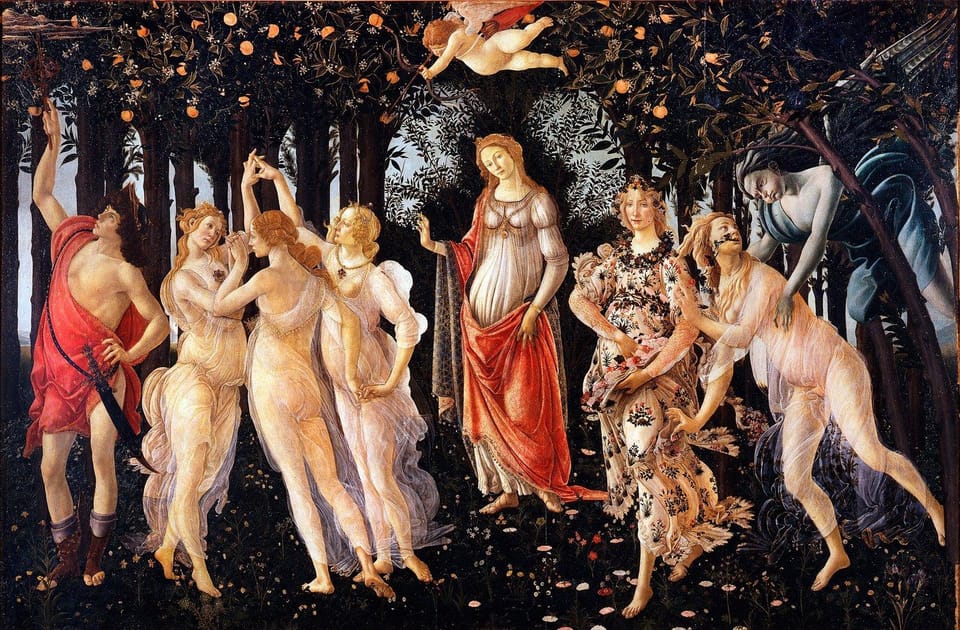
Botticelli is one of those artists who can feel abstract until someone points out what’s going on. On this tour, you’ll focus on two of the most famous works tied to his world: The Birth of Venus and Primavera.
What I like about this part of the experience is the combination of story and visual cues. Botticelli’s figures are elegant, but they’re not just pretty. The guide’s job is to translate what you’re seeing into why it mattered to the Renaissance mindset. You’ll hear the context and stories that make the paintings feel less like static images and more like deliberate art.
If you’re the type who likes to go “wait, what am I looking at,” this is your section. The guide helps you identify themes—so instead of hunting for meaning alone, you’re given a roadmap.
You can also read our reviews of more museum experiences in Rome
Michelangelo’s Tondo Doni: Seeing Sculpture Feelings in Paint
Next up is Michelangelo’s Tondo Doni. The biggest advantage of having a guide here is pacing: this is the kind of work that can pull you in, but only if you know where to look first.
Michelangelo’s style is about form and presence. In paint, you still get that sculptural weight—figures feel solid, like they could step forward. A good explanation makes you slow down and notice the structure, expressions, and how the composition directs your eye.
I like that the tour doesn’t treat this as a checkbox. You get enough guidance to really see why Michelangelo is Michelangelo, even if you only have a short time in the Uffizi.
Caravaggio’s Dramatic Realism: The Emotional Shock
Then the tour turns darker and more intense with Caravaggio. The highlight here is his dramatic realism, which can feel almost confrontational. Caravaggio doesn’t just paint scenes—he paints reactions, tension, and human emotion.
This is where a guide earns their pay. Without context, it’s easy to focus only on the subject and miss the technique behind the feeling. With guidance, you’ll understand what the intensity is doing to the viewer and why Caravaggio’s approach stands out.
If you enjoy art that feels immediate and human, this is a highlight you’ll remember long after you leave. Caravaggio has that way of making you feel like the moment is happening right now—no museum fog required.
Titian and Raphael: Big Beauty, Clear Takeaways
You finish this focused journey with standout works including Titian’s Venus of Urbino and Raphael’s Madonna of the Goldfinch.
Titian’s Venus is famous for a reason, but the helpful part of a guided stop is that you don’t just register the subject—you notice the choices that make it powerful: how the figure is presented, how attention is guided, and what the painting is communicating beyond the surface.
Raphael offers the counterpoint: balance, grace, and a sense of harmony. The guide’s stories give you a way to interpret the scene without turning it into a guessing game. This pairing is smart because it shows range—how Renaissance artists could build very different effects with their talent.
By the end, you’re not just leaving with name recognition. You’re leaving with a mental checklist of what each master does best.
Guide Quality and Pacing: Why Mateo Is a Standout
A tour is only as good as its guide, and the praise for this one is consistent: people highlight excellent guidance and useful information with a good pace. One guide name that shows up here is Mateo, and the takeaway is simple: you’ll feel like you’re moving efficiently and learning something real as you go.
Good pacing matters in art museums. Too fast and you miss details. Too slow and you get numb. This tour aims for the middle ground. With 1.5 hours, the guide has room to explain without sending you into a museum fog.
The languages offered—Spanish, Italian, and English—also help. If you choose your language carefully, the guide’s explanations land better, and the paintings stop feeling like just big names behind glass.
Price and Value: Is $100.40 Worth It?
The price listed is $100.40 per person, and the value here comes from three things you can’t easily replicate on a solo visit:
- Skip-the-line entrance
You’re paying to reduce wasted time at one of the most common pain points in the Uffizi.
- A live license guide
The Uffizi is full of art, but the difference between a confusing museum and a meaningful one is interpretation. This tour gives you that in a short window.
- A focused highlight route
With limited time, choosing a route matters. You avoid the “I saw something but I don’t remember what” effect that happens when you roam without a plan.
Is it expensive? Sure, relative to a self-guided walk. But for people who want the major masterpieces, minimal waiting, and explanations that actually connect, this can feel like a smart use of your Florence time.
If you’re an absolute art pro who enjoys independent reading and slow wandering, you might choose to go solo. If you want your money to buy time and clarity, the value looks stronger.
Who This Tour Suits Best (and Who Might Skip It)
This tour fits well if you:
- Love the big Renaissance names and want help seeing why they matter
- Have limited time and want an organized plan in about 90 minutes
- Prefer not to figure everything out alone in a crowded museum
- Want a guide in Spanish, Italian, or English
You might pass if you:
- Want an unstructured, long museum experience
- Plan to spend most of your time deep-reading plaques and studying at your own speed
- Are traveling with minors who would be participating without an adult (this tour says unaccompanied minors are not allowed)
And if you rely on wheelchair access, the good news is that it’s wheelchair accessible.
Practical Tips for a Smoother Uffizi Visit
Here are a few small moves that will make the tour feel better, not harder:
- Wear comfortable shoes. Even with a guided route, you’re walking inside and keeping pace.
- Bring patience for the start. Security can take longer in high season.
- Pick the language you’re most comfortable with. Explanations are only as useful as how well you follow them.
- Look first, listen second. When you stand in front of Botticelli or Caravaggio, give yourself a few seconds to visually register the scene before the guide starts connecting dots.
This is one of those experiences where your attention really pays off. A little focus turns “famous painting” into “I get it.”
Should You Book This Uffizi Gallery Small-Group Tour?
If you want Botticelli, Michelangelo, Caravaggio, Titian, and Raphael in one efficient 1.5-hour guided plan, this tour makes a lot of sense. The skip-the-line entrance reduces one of the biggest annoyances, and the guide-led explanations help you see more than the obvious.
I’d book it when:
- your Florence time is short,
- you want structured highlights,
- and you care about understanding what you’re looking at.
I’d think twice if you want to linger room-to-room with zero schedule. In that case, you might prefer a self-guided visit.
For most art lovers, though, this is a strong way to get Uffizi’s greatest hits with better use of your time and a guide who keeps the experience moving at a smart pace.
FAQ
How long is the Uffizi Gallery tour?
The tour duration is 1.5 hours.
Does the tour include skip-the-line entry?
Yes. It includes skip-the-line entrance to the Uffizi Gallery through a separate entrance.
Where do I meet the host?
Meet the host in front of the Andrea Obgagna Statue in Piazzale Degli Uffizi, described as the first statue of the left in the corner between Piazzale degli Uffizi street and Via della Nina street.
Where does the tour end?
The activity ends back at the meeting point.
What artworks does the tour focus on?
The tour highlights include Botticelli’s The Birth of Venus and Primavera, Michelangelo’s Tondo Doni, Caravaggio’s dramatic realism, Titian’s Venus of Urbino, and Raphael’s Madonna of the Goldfinch.
What languages are available for the guide?
The live tour guide is available in Spanish, Italian, and English.
Is hotel pickup or drop-off included?
No. Hotel pickup and drop-off are not included.
Are food and drinks included?
No. Food and drinks are not included.
Is the tour wheelchair accessible?
Yes, the tour is wheelchair accessible.
Can unaccompanied minors join?
No. Unaccompanied minors are not allowed.
What should I do before the tour starts?
Arrive at the meeting point about 10 minutes early, and make sure you provide the correct email and phone number so you receive important updates.